
HAkA Urges Aceh Forest Audit, Traces Permits to Investors
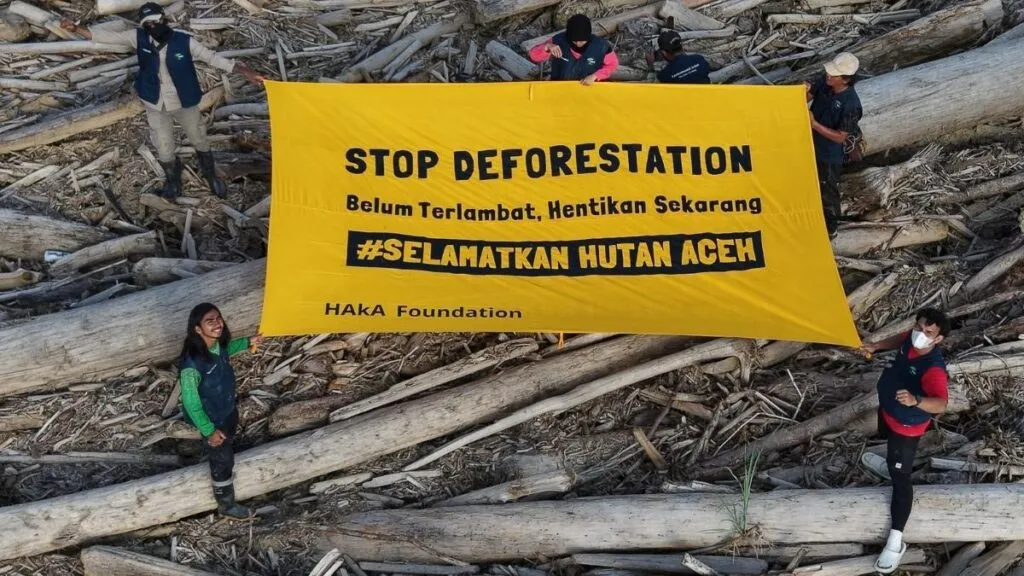
BANDA ACEH – The Aceh Forest, Nature, and Environment Foundation (HAkA) is urging the Aceh Government to immediately conduct a comprehensive audit of the region’s forests and environment. This call follows a surge in forest cover loss that is considered to have reached an alarming level.
Muhammad Fahmi, Legal and Advocacy Manager at HAkA, stated that forest and environmental audits are no longer merely important but have become an urgent necessity. According to his data, the loss of forest cover in Aceh rose sharply from approximately 10,610 hectares in 2024 to 39,687 hectares in 2025.
Of the total forest cover loss, approximately 15,230 hectares are attributed to human activity. According to Fahmi, this situation should serve as a serious wake-up call for the Aceh Government, particularly given that the majority of the forest cover loss occurred within the Leuser Ecosystem Area.

“The surge in forest cover loss should serve as a loud wake-up call for the Aceh Government. The forest audit must assess not only the damage itself but also governance and oversight. We must not simply discover that forests have vanished while failing to identify those who caused, financed, or profited from the destruction, or those who allowed it to happen,” Fahmi told AJNN on Sunday, September 6, 2026.
Fahmi believes that a number of issues must be investigated through an audit, ranging from alleged illegal forest clearing, problematic forest land-use conversion, illegal logging and timber trafficking, mining activities in forest areas, and plantation expansion, to potential overlaps between permits, spatial planning, and forest areas.
Furthermore, the lack of oversight—and even the possibility of willful neglect by the authorities—also warrants investigation. Fahmi stated that the chain of forest destruction must be traced from upstream to downstream.
An audit, he said, must go beyond merely locating missing trees; it must unravel how the timber or resource products left the area—identifying who transported them, what documents were used, where the products were taken, and who ultimately profited.
“Forests are opened up and timber is extracted—who does the hauling, what documents are used, where does the timber or resource output go, who reaps the profits, and who failed or was negligent in their oversight? Unless this chain is dismantled, an audit will yield nothing but figures, while the perpetrators and the systems driving the destruction continue to operate,” he said.
He also cautioned against forest audits becoming merely administrative checks of documents belonging to companies or permit holders. Fahmi argued that inspections focusing solely on document completeness risk leading to the conclusion that an activity appears legal on paper, even though conditions on the ground actually reveal environmental damage.
Therefore, according to him, the audit must encompass the performance and responsibilities of the institutions managing and overseeing the area. The examination must address who is responsible for supervising the area, how patrols are conducted, how public reports are followed up on, and how the government handles known deforestation hotspots and violations.
If the damage persists over the years without effective action, Fahmi stated, an audit must identify the cause—whether the issue stems from limited resources, systemic weaknesses, negligence, or even willful neglect.
“The institutions responsible for managing and overseeing an area—starting right at the site level—must be subjected to a rigorous audit. This is to uncover exactly how governance and oversight are being carried out,” he said.
He also advocates for conducting audits of forest cover changes using spatial data that is subsequently verified through direct fieldwork. The use of satellite imagery, GIS analysis, time-series data on forest cover changes, drones for specific locations, and field verification is considered necessary.
The audit must clearly indicate the locations of lost forest, when the changes began, the extent of the affected area, and the change in land use following the clearing of the forest.

It is important to determine whether the area is being converted into plantations, mining sites, settlements, roads, or other uses.
According to Fahmi, the audit must also compare the legality of the permits with actual conditions on the ground. The inspection covers the permit’s location and coordinate boundaries, its conformity with forest areas and spatial planning, the operational scale, and environmental protection and restoration obligations—including the possibility of activities occurring outside the authorized area.
Audits must not be limited to companies or permit holders alone; activities conducted without authorization or outside official channels must also be included in the scope of the inspection. Issues such as deforestation, forest land-use conversion, illegal logging, mining within forest areas, forest and land fires, encroachment, and the degradation of upstream areas and watersheds must be thoroughly investigated.
“Forest degradation is not just an issue concerning trees. It has direct impacts on flooding, landslides, erosion, water availability, human-wildlife conflict, and public safety,” said Fahmi.
He added that forestry issues do not always hinge solely on the presence or absence of documentation. Inspections must also examine the possibility of activities that exceed, deviate from, or misuse the existing documents.
One aspect considered crucial is the auditing of the timber supply chain and the wood’s origins. Fahmi stated that inspections must not stop at the logging site; the audit must trace the flow of the timber from its source—covering the parties involved in logging, transportation, documentation, and shipment destinations—all the way to the final buyer.
He addressed the scrutiny surrounding allegations that production forest documents were used to disguise the removal of timber from other areas. According to him, these allegations must be verified through document audits, field inspections, and supply chain tracing.
“If action is taken only against workers or transport drivers, while the financiers and those profiting remain untouched, then law enforcement will never put an end to forestry crimes,” he said.
HAkA also called for an audit to trace the flow of money and profits arising from forest destruction.
According to Fahmi, forest destruction always carries economic value. Therefore, investigations must be capable of identifying the parties that profit from timber, land, minerals, or the conversion of the area’s land use.
The investigation, he said, must not stop at the operators in the field but must also encompass financiers, those who receive the illicit goods, ultimate beneficiaries, companies or parties reaping the profits, and any other parties proven to be involved.
“Without tracing the beneficial owners—or the parties reaping economic benefits from the damage—the audit risks targeting only the field-level perpetrators,” he said.
He emphasized that an audit must not simply end as a report or meeting material when serious violations are uncovered.
Fahmi stated that activities proven to damage forests or conducted without a valid legal basis must be halted. Regarding activities or areas currently under serious investigation, the government is also considered capable of taking security measures within its authority to prevent the damage from continuing.
Furthermore, the permit must be evaluated or revoked if serious violations, activities exceeding the scope of the permit, or breaches of environmental protection obligations are discovered.
Law enforcement must also target the entire chain of violations, not just the public or field workers.
“Law enforcement must not stop at ordinary citizens or field workers. It must expose everyone involved—from the field operatives, financiers, and operation controllers to the receivers of the proceeds, the ultimate beneficiaries, and any other parties proven to be implicated,” said Fahmi.
If any suspected involvement by officials or civil servants—whether through abuse of authority, collusion, turning a blind eye, or corrupt practices—is uncovered, Fahmi calls for the matter to be investigated in accordance with applicable legal mechanisms.
“There must be no impunity simply because the perpetrator possesses capital, holds a position of authority, or has a network of power,” he said.
He also emphasized that law enforcement must go hand in hand with ecological restoration. Damaged areas must be restored in accordance with the extent of the damage and their ecological characteristics.
Such restoration may encompass forest rehabilitation, the restoration of watersheds and upstream areas, the recovery of wildlife habitats, and the protection of areas against further degradation.
According to Fahmi, the burden of recovery should not be borne entirely by the state if a party is proven responsible for the damage.
On the other hand, he called for the entire audit process to be conducted independently, transparently, and on a data-driven basis, and to be subject to public scrutiny.
The community, said Fahmi, has the right to know the extent of forest loss, the location of the damage, the cause, the parties who own or control activities in the area, as well as the actions taken by the government.
“If an audit uncovers serious violations, the government must not stop at recommendations. Destructive activities must be halted, perpetrators held accountable, illicit profits traced, and damaged areas restored,” he said.
An audit must serve as a gateway to saving Aceh’s forests, rather than merely becoming another document left to gather dust on a bureaucratic desk.
This article was originally published by AJNN.net under the headline “HAkA Urges Audit of Aceh’s Forests, Tracing Permits and Backers.”

Admin HAkA
Related Posts