
From Floods to Seedlings: Women of Paya Rabo Lhok Cultivate Renewed Hope
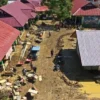
November 2025 was a time the residents of Paya Rabo Lhok Village, Sawang District, North Aceh, would not soon forget. A flash flood, with water levels reaching approximately twelve meters, submerged their homes, plantations, and yards. Trees that had been tended for years were swept away in an instant. For the community members who relied on farming and agriculture for their livelihood, it was not merely their crops that were washed away, but the very source of income that had sustained their families.
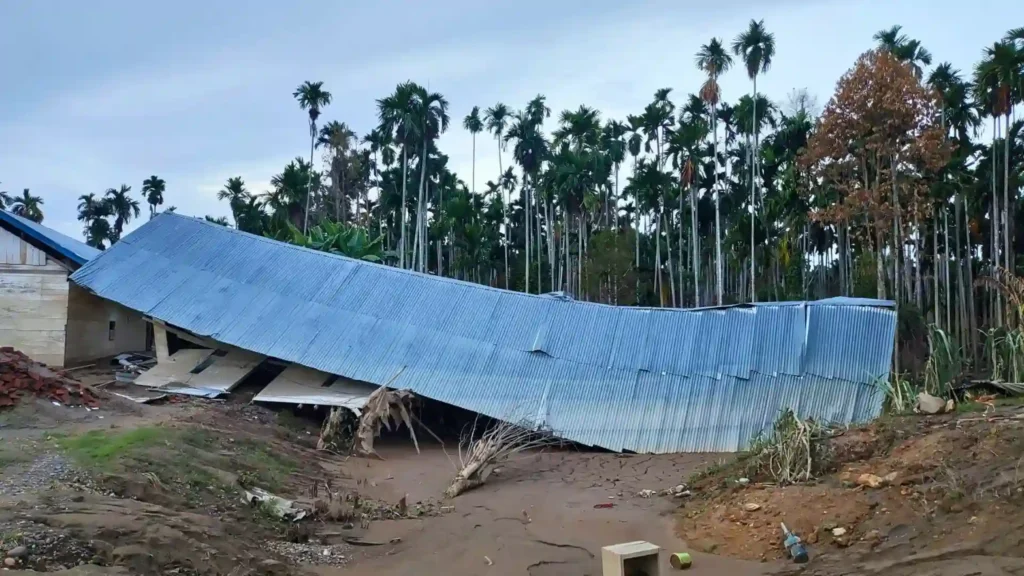
Residents’ homes submerged by flash floods.
In the months following the receding waters, life slowly began to return to normal. While homes could be cleaned and yards tidied, reviving the orchards required far more time; lost trees had to be planted from scratch and nurtured for years before bearing fruit again. Throughout this process, the community was not merely restoring damaged land but also striving to rebuild lives that had been brought to a standstill.
Amidst the recovery process, the Bungong Baroena Women’s Group, together with HAkA, developed a plant nursery.. Built to the dimensions of Measuring 12 by 9 meters, this nursery can accommodate up to 10,000 seedlings, which can later be used to help revitalize residents’ gardens and yards.
In this modest space, seedlings are being prepared for future planting. The nursery also serves as a place for women to learn, share knowledge, and strengthen their ability to independently produce seedlings. It is a step toward restoring what was lost—starting with a single seedling, then a garden, and gradually, a life.
On July 11, 2026, hundreds of seedlings arrived in Paya Rabo Lhok for use in a nursery training session. The atmosphere around the nursery, previously quiet, suddenly became bustling. Members of the Bungong Baroena Women’s Group arrived and, without being asked, pitched in to unload the seedlings from the vehicle. Some carried polybags, others arranged the seedlings, and some prepared the storage area. That simple flurry of activity revealed one thing: there was great enthusiasm to begin replanting.
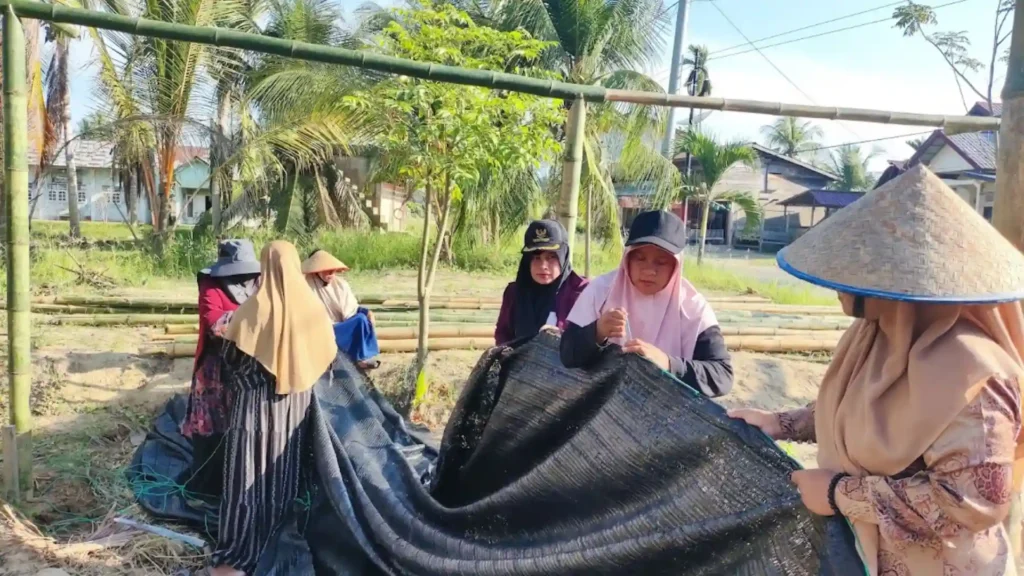
Members of the mutual cooperation group are building a nursery.
Amidst these activities, Nurwida, the leader of the Bungong Baroena Women’s Group, stood observing the seedlings that were beginning to fill the nursery.
“This is one way to entice the community,” he said. “People here enjoy seeing seedlings ready for planting.”
For Nurwida, the arrival of seedlings offers a chance to mobilize residents once more, after many plants in their gardens and yards were lost to the floods. The availability of seedlings signals the possibility of replanting—and gradually rebuilding the livelihoods that had been lost.
However, having seeds alone isn’t enough. The group also needs to understand how to independently produce and care for good seeds. Therefore, the members participated in nursery training with Armiadi, Head of the Tenggulun Restoration Station of the Leuser Conservation Forum. They learned everything from preparing the planting medium and managing the nursery to practicing grafting techniques. grafting to produce seedlings with superior characteristics.
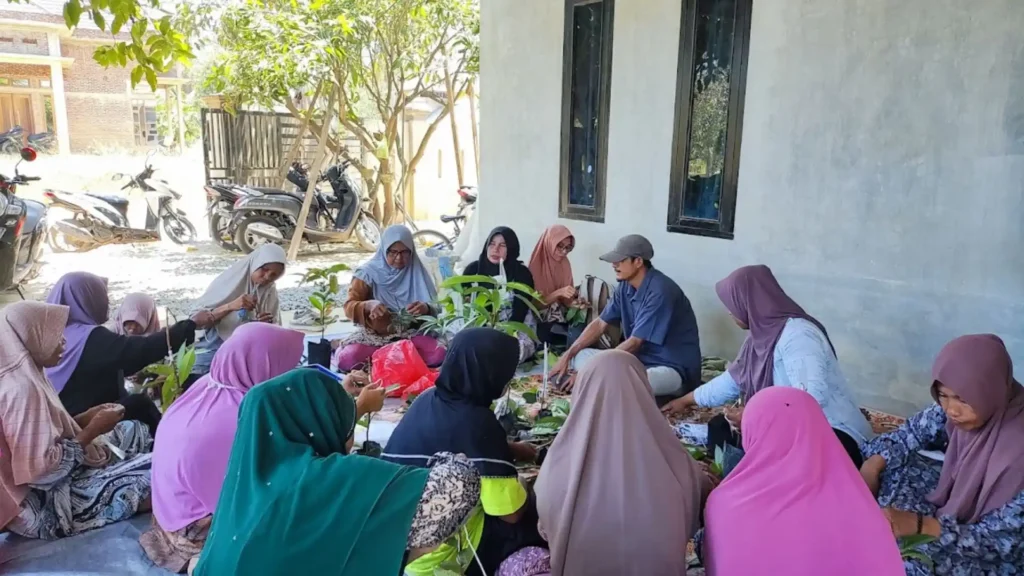
Participants are practicing grafting on guava and cacao seedlings.
Armiadi explained that superior planting stock does not necessarily have to be brought in from outside the area. Many sources of such stock are actually already available within the community, provided people know how to select and propagate them.
“Superior planting stock is actually right around us; we don’t need to go far to buy it. What we need to learn is how to obtain it,” he explained.
One of the techniques practiced is shoot grafting.. Through this technique, a shoot from a tree with desirable traits can be grafted onto a healthy rootstock. This gives the community the opportunity to produce high-quality seedlings using sources available in their own local area.
For some participants, this practice turned out to be completely unfamiliar. A group member around fifty years old suddenly raised his hand.
“I used to make this on paper flowers,” he said with a smile.
That simple remark transformed the learning atmosphere. The technique being practiced turned out to connect with knowledge they had already used in their daily lives. That knowledge had not been lost; it simply needed to be recalled, shared, and developed together.
That day, hands accustomed to tending the home, the garden, and the family began attempting to graft guava and cacao shoots, one by one. Not every attempt was perfect from the start. Yet, every successfully grafted seedling stood as the fruit of the courage to try again.
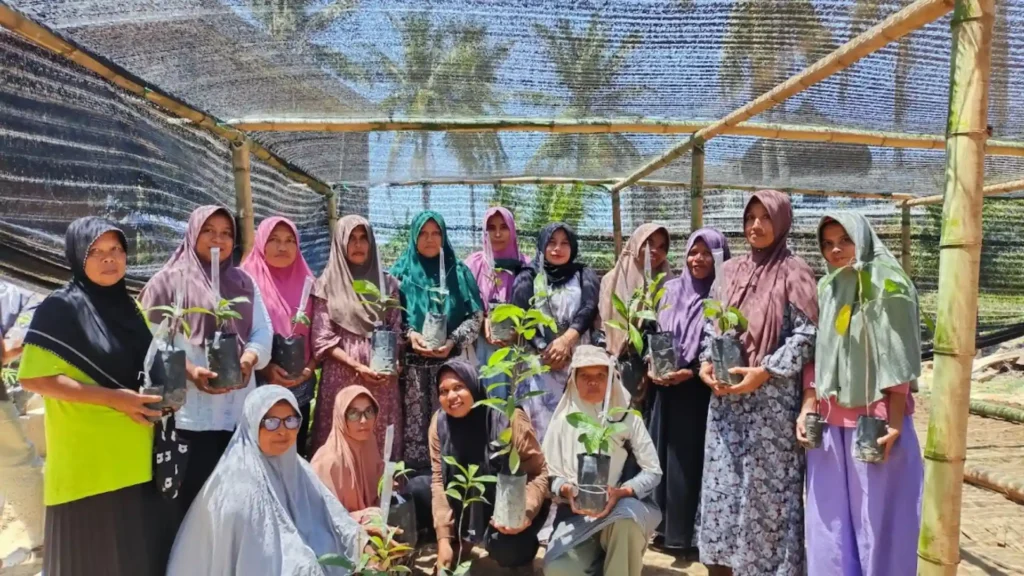
Group photo with the group members, each holding their own grafted seedling.
A week later, the group members gathered again at the nursery. They examined the previously grafted seedlings one by one. Young shoots were beginning to emerge from some of the scions.
The shoot is a sign that the grafting was successful.
For the group, these small successes felt significant. They not only saw the plants beginning to grow but also realized they could put their newly acquired skills into practice on their own. Gradually, the nursery evolved into more than just a place to store seedlings; it became a space for learning, experimenting, and building the confidence that they were capable of preparing some of the plant stock needed for their own gardens.
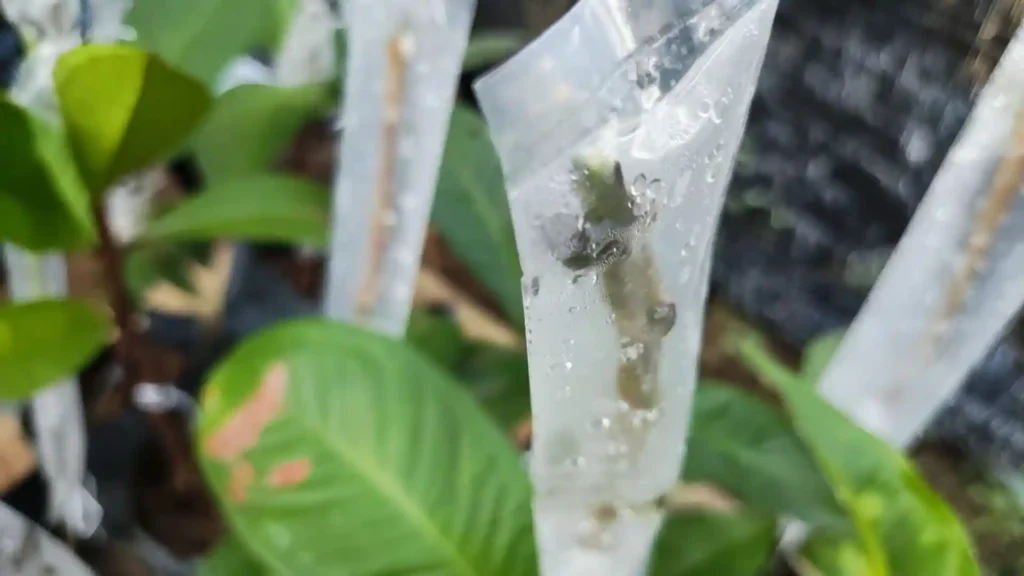
The grafted seedlings are starting to grow.
The shoot is a sign that the grafting was successful.
For the group, these small successes felt significant. They not only saw the plants beginning to grow but also realized they could put their newly acquired skills into practice on their own. Gradually, the nursery evolved into more than just a place to store seedlings; it became a space for learning, experimenting, and building the confidence that they were capable of preparing some of the plant stock needed for their own gardens.

Admin HAkA
Related Posts